
Choosing the right golf polo shirt manufacturer is not only about finding a competitive price. For golf apparel brands, wholesalers, clubs, and private-label buyers, the real challenge is finding a supplier that can consistently reproduce the right fabric, fit, collar construction, logo quality, and color across both the first order and future reorders.
A good golf polo may look simple, but manufacturing one involves more than sewing a collar onto a performance shirt. Stretch, moisture management, collar structure, shoulder mobility, decoration, sizing, and fabric stability all affect the final product.
Before committing to bulk production, here are six things buyers should look for when evaluating a custom golf polo manufacturer.
A factory that manufactures general T-shirts is not automatically a good golf polo manufacturer.
Golf polos have their own requirements. The garment needs enough movement through the shoulders and upper body for a golf swing while still maintaining a clean, professional appearance. Collars need to keep their shape, plackets need to sit flat, and stretch fabrics need to be handled correctly during cutting and sewing.
A manufacturer with golf apparel experience should understand details such as:
When evaluating a supplier, ask to see recent golf polo samples or production examples.
You can also ask what percentage of their business is related to golf or performance apparel. A supplier specializing in golf clothing will normally provide more useful recommendations than a general garment factory that simply agrees to whatever specifications you send.
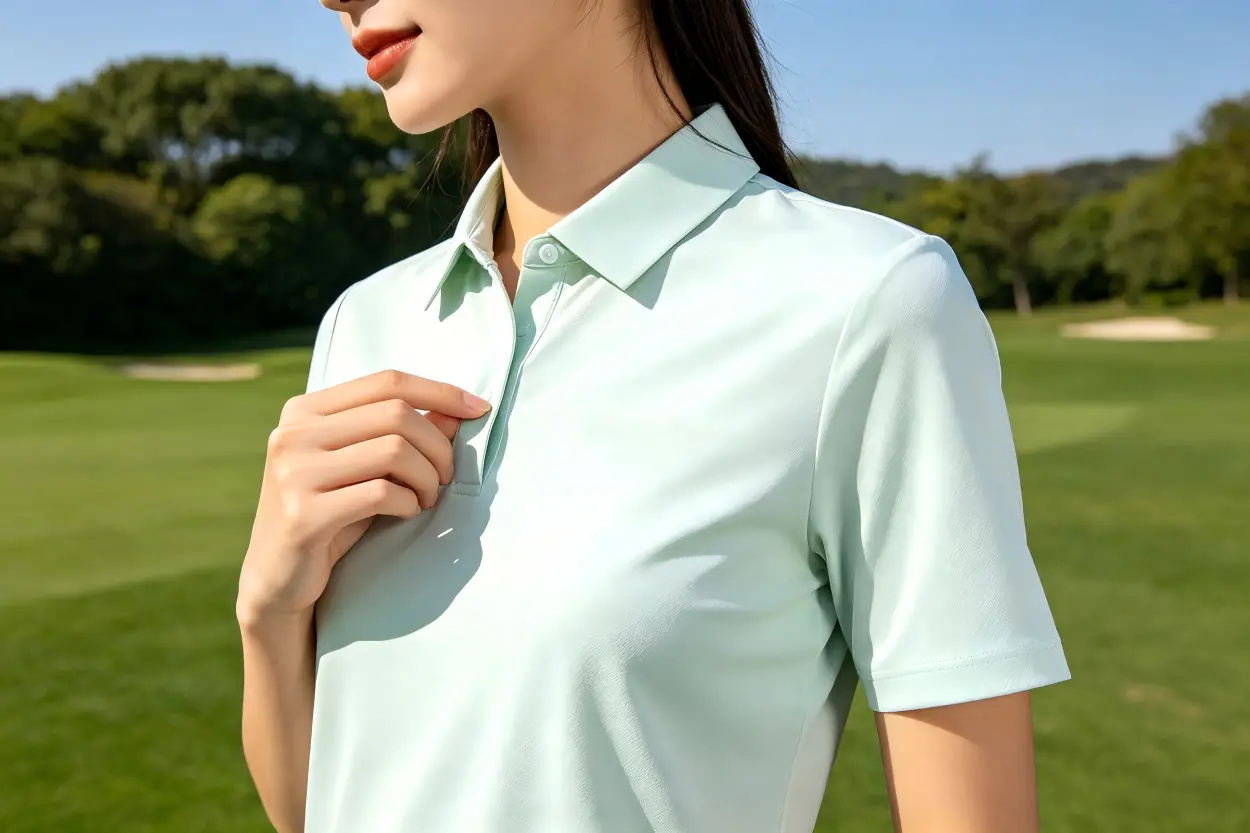
Fabric has a major influence on how a golf polo feels, performs, washes, and looks after repeated use.
Instead of asking only, "Do you have polyester fabric?", discuss the actual performance requirements of the product.
For example:
| Requirement | What to Discuss |
|---|---|
| Hot-weather golf | Lightweight, breathable construction |
| Active performance | Moisture-wicking and quick-dry properties |
| Greater mobility | Mechanical stretch or spandex blend |
| Premium appearance | Fabric surface and drape |
| Frequent washing | Colorfastness and dimensional stability |
| Retail positioning | Hand feel, GSM and finishing |
There is no single "best" golf polo fabric.
A lightweight polyester fabric may work well for hot climates, while a polyester-spandex blend may be more appropriate when stretch and recovery are priorities. Pique, jersey, jacquard, mesh structures, and other performance knits can also produce very different results.
A capable manufacturer should ask about your target market, retail positioning, climate, fit, and expected performance before recommending a fabric.
Be careful with suppliers that only send a fabric catalog without explaining why a particular option fits your product.
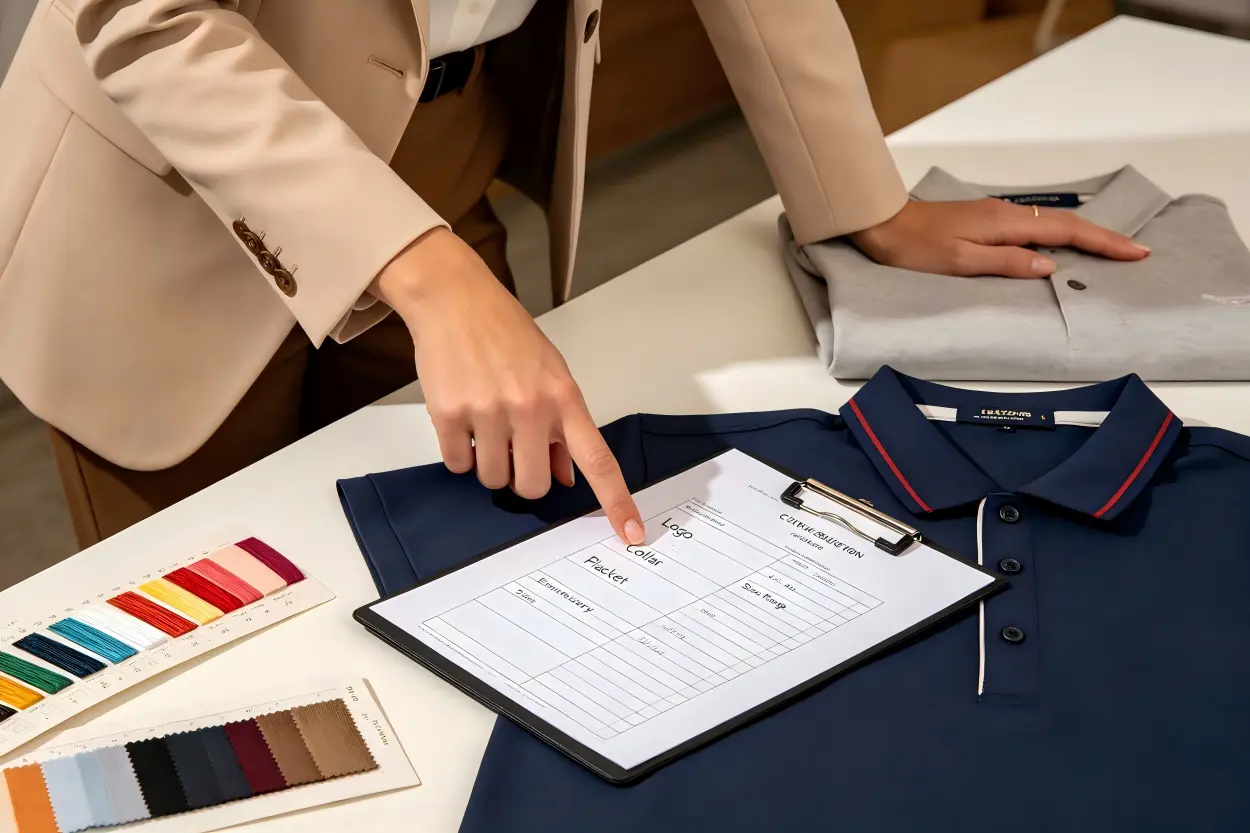
For a golf apparel brand, customization should go much further than adding a logo to an existing polo.
A proper OEM/ODM manufacturer should be able to develop the garment around your specifications.
Depending on the project, this may include:
This is especially important for private-label brands trying to build a recognizable product rather than buying another supplier's standard polo.
Before ordering, confirm exactly which components can be customized and which depend on existing materials or minimum quantities.
A good manufacturing partner should also tell you when a requested detail creates unnecessary cost or production risk. Technical recommendations are often more valuable than a supplier that simply says "yes" to every request.
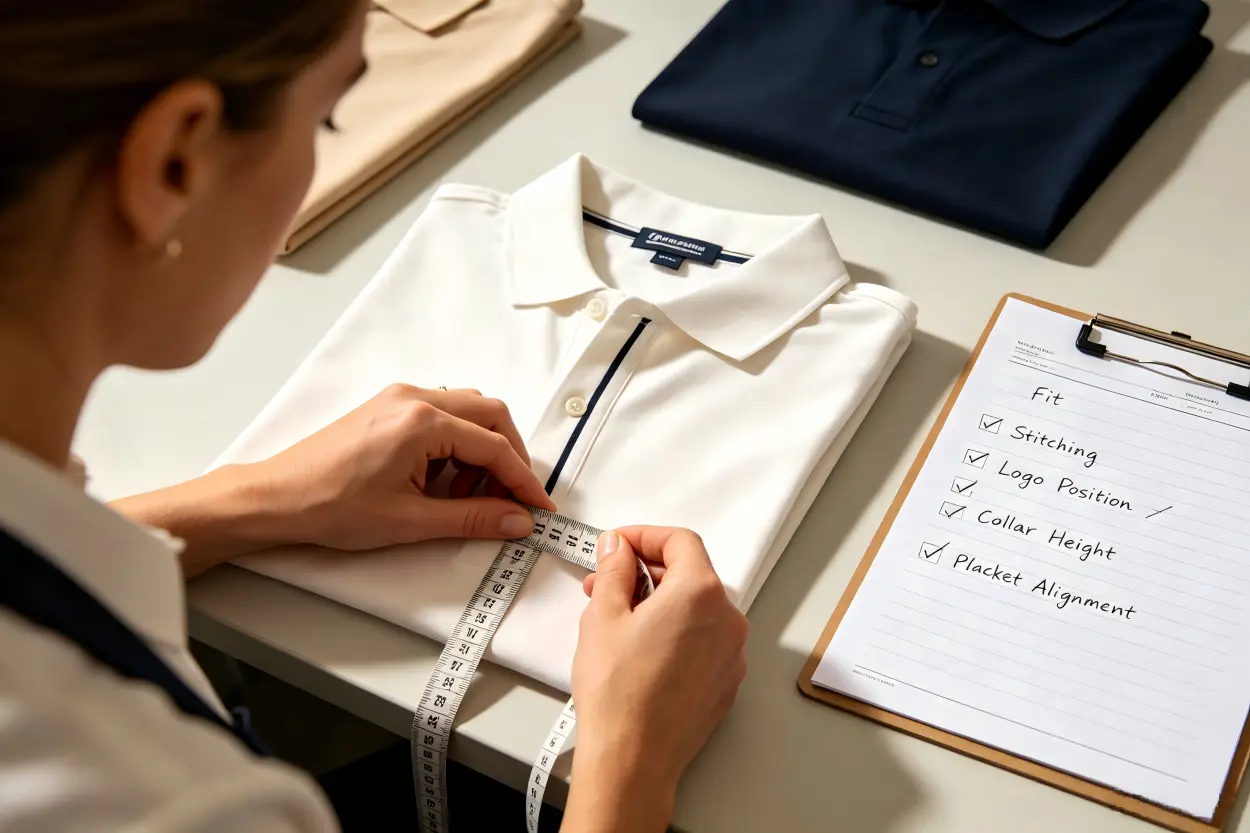
Never evaluate a golf polo manufacturer only from website photos.
The sample development stage is where you can check whether the supplier can actually translate your specifications into a finished product.
Before approving bulk production, review:
Sampling is particularly important when developing a new fit or using a new performance fabric.
The approved sample should become a reference for bulk production.
Quality control should then continue throughout manufacturing rather than happening only after every polo has already been completed.
A practical QC process normally includes checks before cutting, during sewing, and before shipment.
For brand owners, consistency matters just as much as the quality of one individual shirt. Ten perfect samples are not useful if the bulk order contains inconsistent measurements, logo positions, or colors.
Many manufacturing problems begin with communication rather than sewing.
For example, "navy blue," "lightweight fabric," or "slim fit" can mean very different things to different people.
A reliable manufacturer should help turn these descriptions into measurable specifications.
Before production, important details should be confirmed clearly, including:
Pay attention to how the supplier communicates during the quotation and sampling stage.
Do they answer technical questions directly?
Do they identify missing information?
Do they suggest solutions when something may not work?
These early conversations are often a good indication of what working with the supplier will be like during bulk production.
For international buyers, clear communication can reduce expensive misunderstandings before they reach the production line.
Your first order is important, but for a growing golf brand, the second and third orders may be even more important.
A good supplier should think beyond one production run.
Ask how they record your:
If you reorder the same golf polo several months later, the new production should remain as close as possible to the approved version.
This is why the lowest unit price should not be the only factor in supplier selection.
A slightly cheaper polo can become expensive if the next order uses a different fabric, the collar changes shape, or measurements are inconsistent.
You should also ask for realistic timelines for sampling, approvals, material preparation, bulk production, inspection, and shipping.
Extremely short promises are not always a good sign. Reliable planning is more valuable than an unrealistic delivery date designed to win the order.
Before placing a bulk order, ask yourself:
If several of these answers are unclear, investigate further before paying a deposit.
The best golf polo shirt manufacturer is not necessarily the factory offering the cheapest quotation.
For brands and private-label buyers, the stronger partner is usually the manufacturer that understands golf-specific product development, recommends appropriate performance fabrics, manages customization carefully, controls quality, communicates clearly, and can reproduce the same product across repeat orders.
At EWO Golf Apparel, our focus is on OEM/ODM and private-label golf apparel development for brands, wholesalers, distributors, clubs, and international buyers. We support projects from fabric and product development through sampling, customization, bulk production, and final quality control.
If you are developing a new golf polo collection, start by sending your design, reference sample, size chart, logo artwork, or target product requirements. A good manufacturing project should begin with clear specifications—not simply a unit-price quotation.
Ask about their golf apparel experience, available performance fabrics, customization capabilities, sample development process, quality control, MOQ, production timeline, and how they maintain consistency for repeat orders.
For a custom or private-label golf polo, sampling is strongly recommended. It allows you to check fabric, fit, collar construction, measurements, logo placement, and workmanship before committing to the full production quantity.
Not necessarily. Unit price should be considered together with fabric quality, customization, communication, production reliability, quality control, and reorder consistency. For growing brands, reducing production risk can be more valuable than choosing the lowest initial quotation.